About the portal
Multimodal RNA phenotypes for human genetics
Pantry and LaDDR transform population-scale RNA-seq data into phenotypes that capture diverse forms of transcriptomic variation. This portal provides those phenotypes and their genetic analyses across human tissues.
From RNA-seq to genetic analysis
Pantry measures biologically defined RNA features, while LaDDR learns patterns directly from RNA-seq coverage. The hybrid analyses in this portal combine Pantry phenotypes with residual LaDDR phenotypes that characterize additional variation in the coverage data.
Six interpretable modes of RNA regulation
Additional within-gene coverage variation
cis-xQTL and xTWAS results across tissues
Knowledge-driven phenotyping
What is Pantry?
Pantry is an extensible framework for measuring multiple forms of RNA regulation from population-scale transcriptome data and carrying those measurements into genetic analyses. The current resource includes six modalities: expression, isoform ratio, intron excision ratio, alternative transcription start site, alternative polyadenylation, and RNA stability.
These phenotypes have direct biological interpretations. Pantry maps their genetic regulation jointly within each gene, then supports integration with GWAS through xTWAS and colocalization analyses.
Read the Pantry paper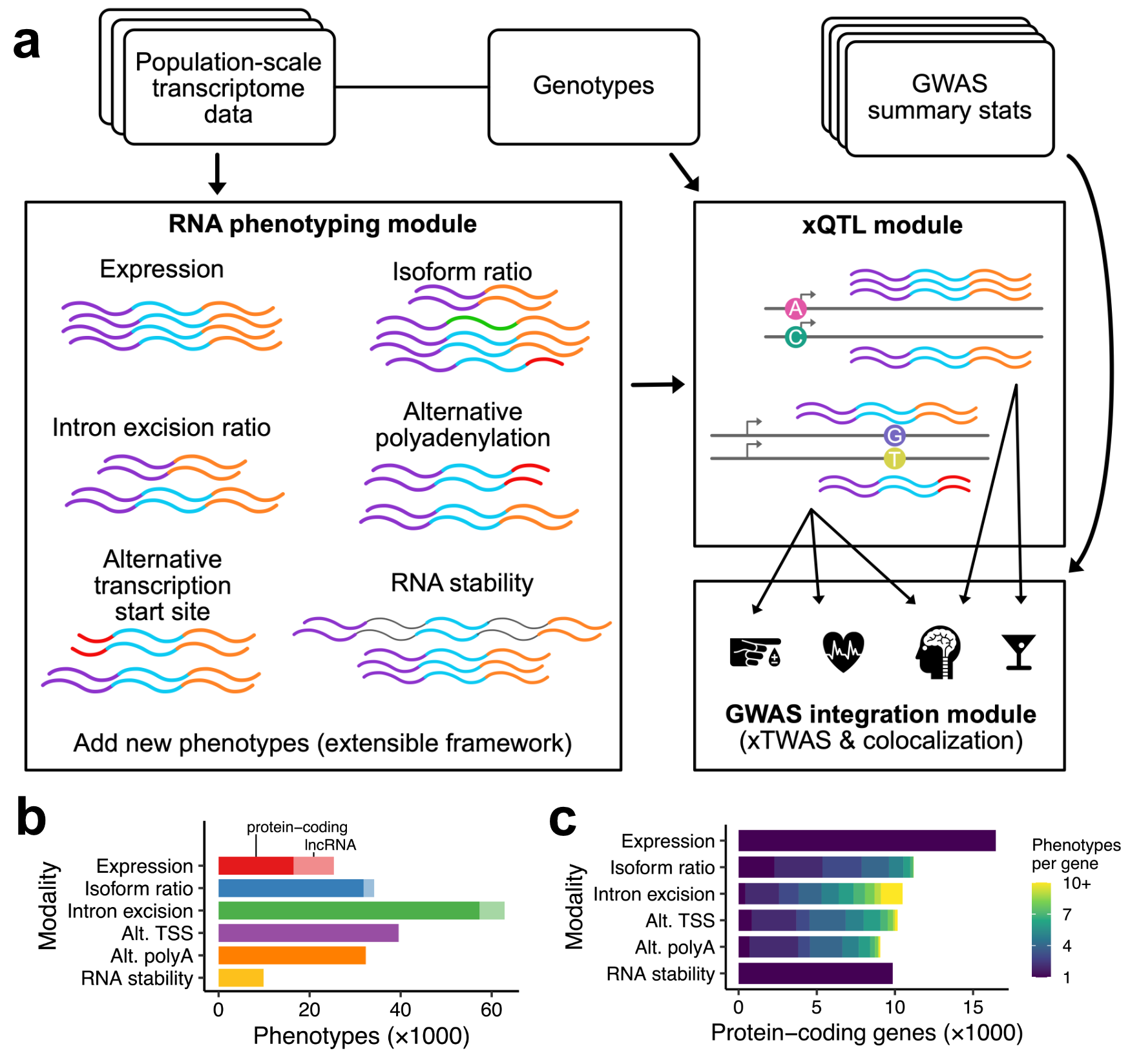
Data-driven phenotyping
What is LaDDR?
LaDDR partitions each gene and its flanking sequence into bins, then learns major axes of normalized RNA-seq coverage variation across samples. The resulting data-driven phenotypes can represent familiar or previously unmodeled transcriptomic patterns without requiring each pattern to be specified in advance.
LaDDR can be applied on its own or after known Pantry phenotypes are regressed from the coverage features. In the latter setting, its residual phenotypes supplement Pantry by describing additional variation rather than duplicating the six knowledge-driven modalities.
Read the LaDDR paper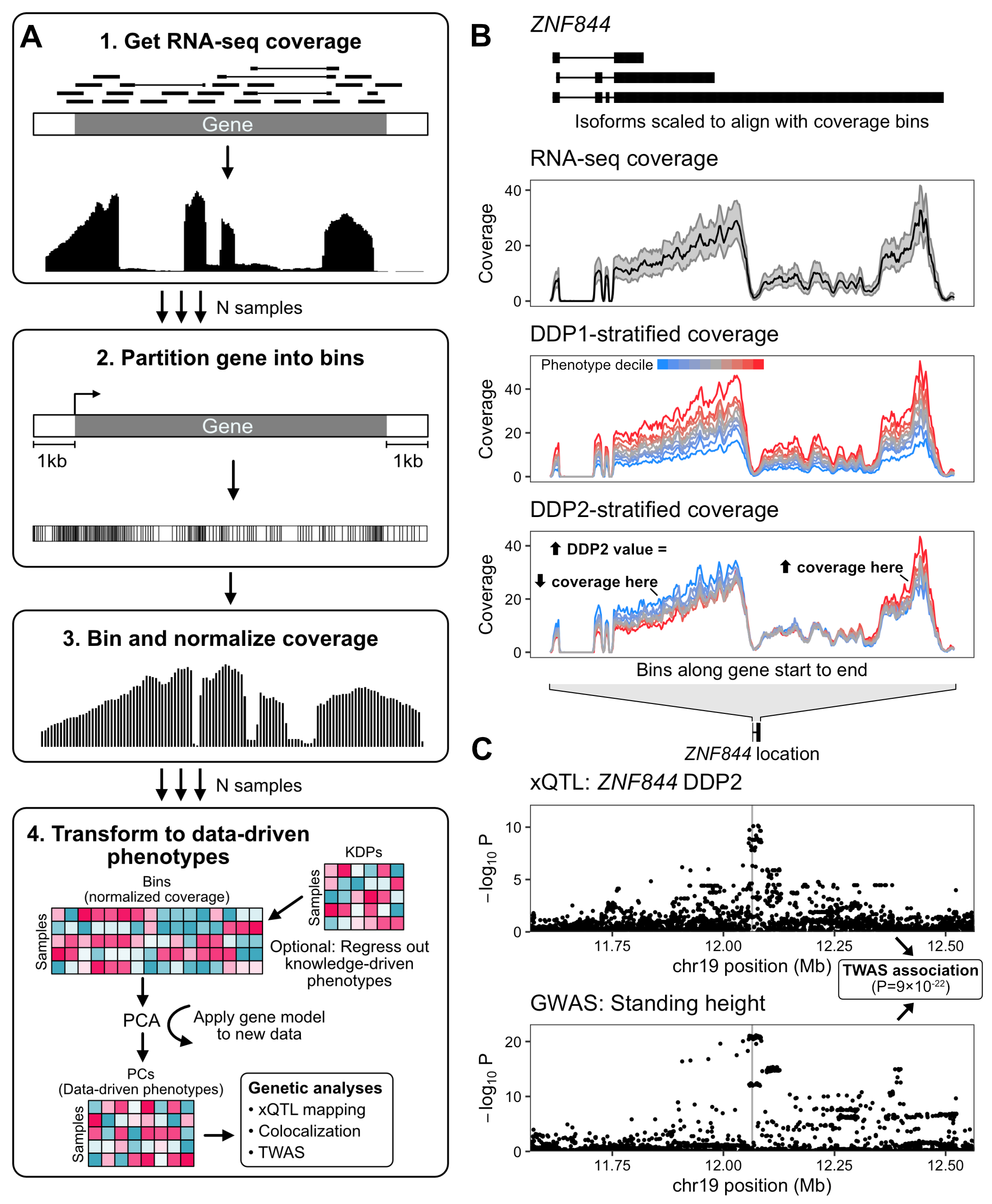
From methods to reusable data
Why use the portal?
These data can support transcriptomic and genetic studies in human populations. Researchers can use the portal to examine whether a gene or trait is linked to a specific, interpretable RNA modality, to an additional data-driven pattern, or to both.
- Compare results across 49 GTEx tissues and Geuvadis.
- Browse significant xTWAS associations and conditionally independent cis-xQTLs.
- Search by gene or GWAS trait to connect results across analyses.
- Download phenotypes, covariates, xQTL results, xTWAS models, and associations.